SiPM based technology
with Time-of-Flight capability
What is the benefit of Time-of-Flight?
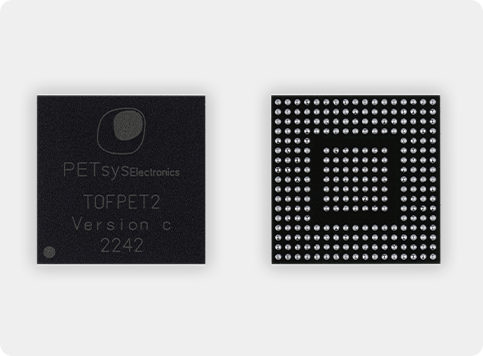
PETsys Electronics technology is based on the TOFPET ASIC (Figure 1). It provides a cost effective way to use Time-of-Flight (ToF) to improve the "equivalent sensitivity" of PET systems. The gain in sensitivity implies sharper images with substantially less noise (see Figure 2). The ratio of the patient torso diameter to the uncertainty of the location of the gamma rays emission along the Line-of-Response (line joining the interaction points of the two gammas in the detector) determined by the Tof measurements, has been shown to be representative of the sensitivity gain. The signal-to-noise ratio (SNR) of the PET images is improved by the square-root of the sensitivity gain factor.


What is the ToF performance of PETsys detectors?
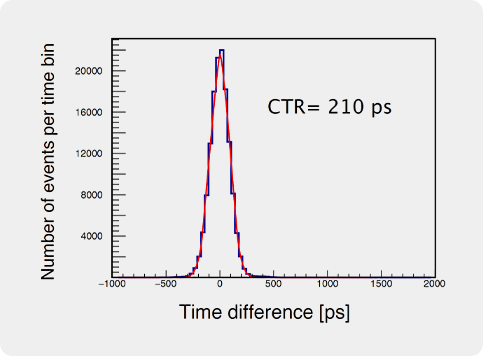
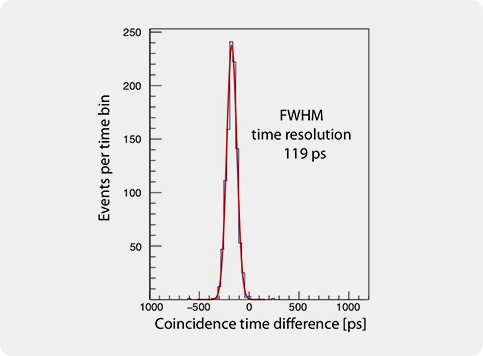
PETsys Detector Modules, based on LYSO crystal arrays (3x3x15 mm pixels), MPPC silicon photomultipliers and PETsys TOFPET ASICs, have Coincidence Time Resolution (CTR) of ~300 ps FWHM (Full Width Half Maximum) - see Figures 3 and 4. The corresponding uncertainty of the emission point is about 4.5 cm FWHM. Knowing that the torso diameter of a typical patient is ~30 cm we conclude that PETsys techonology allows a gain in sensitivity of a factor 6.5, and a gain in SNR of a factor 2.5. This algo means that the same image quality as with non-TOF PET is achievied with shorter exam time or with lower radiation close to the patient by a factor 6.5
Application to small animal or breast PET
In some applications, e.g. in small animal PET systems or breast PET, the sensitivity gains from ToF are smaller but a better coincidence time resolution allows the reduction of random coincidences noise. This is an important consideration in high rate applications. Also in this case scanners based on SiPM will lead to a more compact and cost effective solution.
Straightforward integration of SiPM-based PET scanners
PETsys state of the art data acquisition technology based on high-speed point-to-point links allows the straightforward integration of SiPM-based PET scanners. The technology is scalable to systems with several tens of thousand channels and allows for a staggering total rate of singles in the PET scanner of 1 Giga hit per second.